
Intersectionality as the Opposite of Decoupling

Sarah Constantin describes cognitive decoupling as:
[T]he ability to block out context and experiential knowledge and just follow formal rules, as a main component of both performance on intelligence tests and performance on the cognitive bias tests that correlate with intelligence. Cognitive decoupling is the opposite of holistic thinking. It’s the ability to separate, to view things in the abstract, to play devil’s advocate.
Or, to paraphrase Nate Silver from his new book On the Edge, decoupling is the ability to say, “I may disagree with Chick-fil-A’s views on gay marriage, but they make a damn good chicken sandwich!”
Decoupling is partly a cognitive process and partly a personality trait. I think that with enough conscious effort, anybody has the ability to put their feelings on gay marriage aside and admit that the Spicy Chicken Sandwich tastes like heaven. But it is much easier for some people than others to disregard their feelings and context, and only focus on the facts of a particular matter. High-decouplers have a much easier time agreeing with parts of an argument while disagreeing with others, or admitting that a controversial figure has both positive and negative traits.
(As an aside, some psychologists1 have suggested that autism and schizophrenia exist on a spectrum of high- vs. low-decoupling. Autism is an example of extreme decoupling, where the person is so focused on their hyper-fixations that they miss everything else and fail to pick up on nuanced social patterns. Schizophrenia is an example of extreme lack of decoupling. Schizophrenics tend to view everything in the world as somehow connected, which makes them prone to being disorganized and conspiratorial.)
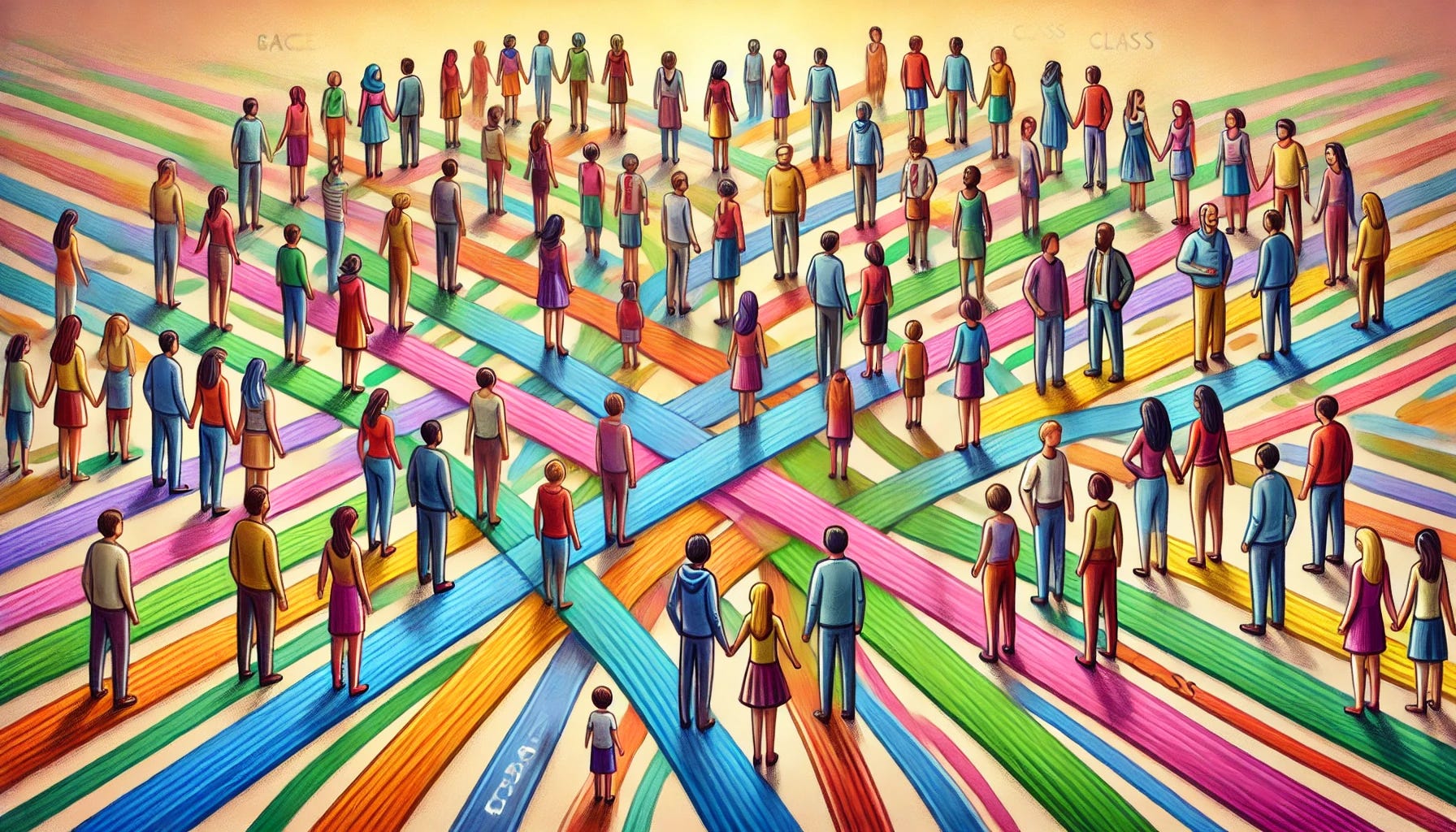
“Intersectionality” is one of the most ubiquitous concepts within the last 15 years of leftist discourse. In a nutshell, intersectionality claims that you cannot consider each axis of identity or oppression merely on its own; you must consider it in the context of every other axis of identity and oppression.
(Edit: I should be clear that I am not an expert on sociology or the works of Kimberlé Crenshaw, though I have read some of them. I am mainly discussing intersectionality as it has be used and interpreted — some would say misused and misinterpreted — in the public discourse and on the college campuses where I live. In other words, I care more about intersectionality as applied in the real world than about intersectional philosophy in academia.)
Intersectionality is a main theme of Ibram X. Kendi’s famous 2019 book How to Be an Antiracist, where he devotes multiple chapters to topics other than racism. He claims that an anti-racist must also be anti-capitalist because capitalism hurts poor Black people more than poor white people. He claims that an anti-racist must also be feminist because misogyny hurts Black women more than white women. He claims that an anti-racist must also be pro-LGBT because homophobia and transphobia hurt queer Black people more than queer white people.
This is, in some ways, the complete opposite of decoupling.
Whereas a decoupler prefers to consider each issue separately and come to independent conclusions, intersectionality demands that you adopt an entire slate of opinions on many disparate topics.
Whereas a decoupler prefers to separate an argument from the person making it – even considering it a fallacy to focus on who a speaker is rather than the content of their speech – intersectionality demands that we “contextualize” everything and care about identity politics. Some leftists consider it a sin for a white person to contradict a POC on matters of race, and believe that ideas should be taken more seriously if they come from a “marginalized” perspective.
Whereas a decoupler is more likely to support piecemeal, incremental reform – believing that improvements in at least some areas are better than improvements in none – intersectionality tends to promote revolution, either literal or metaphorical. If even one person is oppressed, the thinking goes, then none of us are free.
The intersectional mindset can be seen very clearly within the recent wave of Palestinian protests across America. If you've ever been to one of these protests, you'll know that they don't just talk about the Israel-Palestine conflict. Activists will also promote Black Lives Matter, police abolition, prison abolition, socialism, gay rights, trans rights, abortion rights, divestment from fossil fuel companies, open borders, the “liberation” of Kashmir from India, and about a dozen other progressive causes. To a decoupler, these are unrelated issues which make no sense to group together. But to an intersectional activist, these are all examples of oppressor vs. oppressed, where the oppressed peoples of the world must come together to fight as one.
Intersectional thinking comes very naturally to certain types of people. (I think it's no coincidence that woke activism is most common among upper-class liberal-arts college women.) But intersectionality also rubs a lot of people the wrong way, myself included. It's not because I necessarily disagree with their object-level opinions – I would consider myself progressive on most issues – but because the intersectional outlook is fundamentally at odds with my high-decoupling personality.
Before any right-wing readers get too smug, I would like to make a few things clear.
Firstly, leftists are capable of high-decoupling, at least sometimes. Take, for instance, queer activists for Palestine. Zionists love to clown on these people, calling them “Chickens for KFC”. Don’t these idiots realize that Hamas would stone them to death? But when you actually listen to the gays for Gaza, they aren’t stupid; they’re practicing decoupling! They are willing to say, “Yes, Hamas is evil, but Hamas is different from the Palestinian civilians. And even though many Palestinians are unfortunately homophobic, not all homophobes deserve to be killed. Therefore, it is still wrong to bomb Gaza.” Gays for Gaza might seem ironic at first glance, but there is nothing inconsistent about it.
Secondly, while it is easy to criticize leftists for their woke intersectionality, the right has its own form of anti-woke intersectionality. There is a large cluster of MAGA people who oppose masking, oppose vaccines (or at least vaccine mandates), oppose abortion, oppose immigration, oppose drag queens, oppose “biological men” being in women’s sports, support Christian prayers in public schools, support more oil and coal extraction, and who are bizarrely paranoid about pedophiles and groomers lurking around every corner.2 The fact that so many conservatives hold the same slate of opinions on such unrelated topics is evidence of low-decoupling among much of the MAGA movement.
So I wouldn’t say that decoupling is a right- vs. left-wing thing. It seems that extremists across the political spectrum are prone to low-decoupling, whereas centrists and policy wonks are prone to higher-decoupling.
As stated above, decoupling is just as much about personality and temperament as anything else. Although I think people should practice decoupling more often, it is unrealistic to expect everyone to become an extreme decoupler like myself. It is human nature to join tribes and then adopt the same beliefs as other members of your tribe, regardless of whether those beliefs belong together or are even internally consistent. I just hope more people can become cognizant that this is happening.
No post of mine is complete without the obligatory Scott Alexander reference.
For the record, pedophilia is obviously a problem. But if you’re in public wearing a t-shirt that says “KILL YOUR LOCAL PEDOPHILE”, then you’ve officially gone off the deep end.